Essay Series
A Future Worth Wanting
The hopeful vision for the AI age is not mass idleness or elite abundance. It is a society with more dignity, more ownership, more time, and more room for human beings to be human.
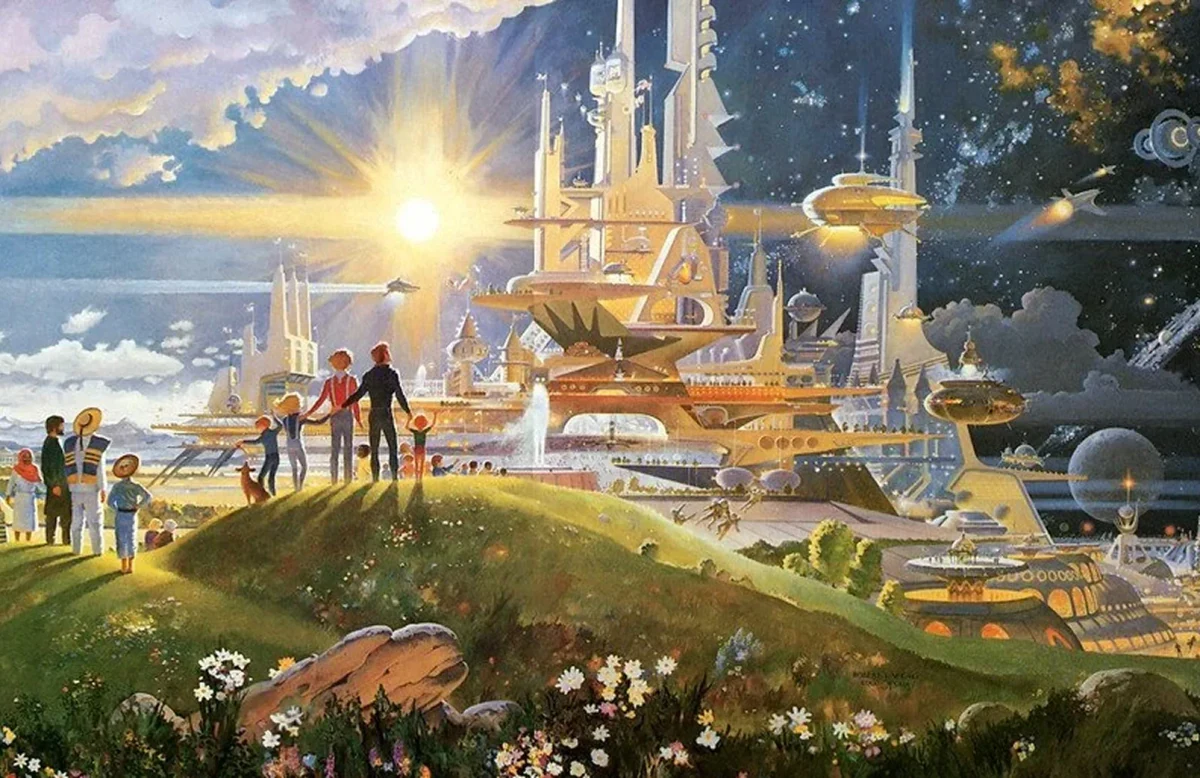
Retro futurism: Source unknown
The first essay was about a mistake: treating the transition like the destination. The second was about what cheap coordination makes newly buildable. This one is about the question sitting under both. What's all of it for?
People don't only fear losing a job. They fear becoming unnecessary — that if the machines can do more of the work the market used to pay people for, the people themselves count for less. The fear makes sense. We built a culture that teaches it. Paid work has been asked to carry far too much: income, status, identity, routine, friendship, dignity. For a lot of people the job is the thing that says where they stand, how the day is shaped, who they know, whether they're allowed to feel useful. So when the work breaks, the loss doesn't stay economic. It goes existential.
That's why our language for job loss is so thin. We say retraining and upskilling because we don't have better words for what's actually lost: rhythm, standing, belonging, a believable story about why your effort matters. AI is about to lean on that whole bundle.
I don't come at this from a distance. I think about it constantly with my own kids — what skills actually compound in a world where abstraction gets cheaper every year. The answer keeps landing in the same place: the physical, the local, the relational, the high-trust, the hard-to-fake. That's the question this essay is circling. Not whether the machines can do the work. What people are for once they can.
The labor market can't tell you what a person is worth
A market wage tells you something real. It tells you what a kind of work is worth right now, inside the current institutions, given the current mix of supply, demand, law, and technology. Useful information. Not a moral verdict. The market can price a role. It can't appraise a person.
Some of the most important work anyone does has never fit cleanly into a wage. Raising kids. Caring for aging parents. Mentoring someone young. Keeping a household steady. Showing up for a neighbor. That work lives in another sphere — family, church, neighborhood — with its own logic and its own kind of honor. The labor market was never built to measure it. We started using its numbers anyway, and somewhere along the way we confused the accounting for the judgment.
That confusion turns dangerous when routine cognitive work gets cheap. If a society treats wage value as human value, then any technology that drops the market price of certain work looks like it has lowered the worth of the people doing it. It hasn't. The person didn't get smaller. The payroll system was never big enough to hold the meaning we hung on it.
A humane future isn't mass idleness
There's a cheap optimism that pictures the machines doing the work while people drift into permanent leisure, surrounded by plenty and entertained into contentment. It sounds good for about seven seconds. Then the floor drops out. A society of passive consumption isn't a hopeful one. It's a sedated one.
People need more than comfort. They need responsibility, standards, the satisfaction of doing something hard and doing it well. They need to be useful to other people in ways that don't reduce to a transaction, and a reason to get up that beats another personalized feed of machine-made amusement. Abundance without purpose doesn't make people whole. Mostly it makes them softer, lonelier, easier to distract. You don't need a degree to have watched it happen — people getting richer and more entertained and less rooted at the same time. The pattern's old. Prosperity slides into complacency, complacency into decadence. Comfort is a blessing when it sits on top of a life with structure. It's a problem when it replaces one.
This is where thin techno-optimism runs out of road. It assumes that once the material needs are handled, meaning shows up on its own. Sometimes it does. Usually it has to be made — out of duties, relationships, practice, belief, craft, membership; out of being needed and corrected and counted on and handed something worth carrying.
So the real question isn't how to keep everyone busy with the same work as before. It's what people get freed for. Automation should retire drudgery — the repetitive, pointless, paperwork-clogged work that never deserved a human life. A better future isn't one where nobody works. It's one where less of life goes into feeding systems and more goes into becoming capable, useful, rooted, responsible. Before industrial life narrowed adulthood down to holding a salaried slot, the picture was wider: keeping a home, raising a family, mastering a trade, serving a place, working the land, caring for kin, making things that outlast you. Wage labor was part of that. It was never the whole of it. AI changes what's possible there. Not automatically. But really.
Use abundance to buy back time
If AI actually raises productivity, the gains should show up where people live — not just in valuations and earnings calls and charts of output per worker. In life. Families with more room to breathe. Health systems that stop making clinicians moonlight as data-entry clerks. Schools that give teachers time to teach. Agencies that quit burning weeks of people's lives on procedures that could have been simple.
A young couple starting a family without panic. A nurse getting home with something left in the tank. A small business owner staying alive without drowning in forms. An aging parent cared for without blowing up the finances of three generations. If the technology is real, the payoff should get boring and concrete. More dinner at home. Less pleading with systems. More slack in the day. That sounds modest next to the usual AI talk. It shouldn't. Most people don't want a science-fiction future. They want the basic conditions of life to stop feeling like a maze built by a committee that never has to walk it.
Human work gets more human
As the routine gets automated, the work that's left doesn't vanish. It moves — toward judgment, trust, care, presence, responsibility. Somebody still has to decide when the rule doesn't fit the case. Somebody has to notice that the patient is sliding, the kid is scared, the building feels wrong, the team is coming apart, the recommendation is technically right and practically useless. Somebody has to answer for it when things go bad.
The roles that last will be the ones closest to consequences. The further work sits from real stakes, the easier it is to automate; the closer it sits to the mess, the more it needs a person who can see, judge, adapt, and stand behind the result. That points at a different idea of education. The future doesn't need an army of professional prompt-whisperers. It needs adults who can use the tools well, think straight, learn a domain deeply, work with other people, and carry real responsibility. Apprenticeships. Practical training. People who know how to work with their hands, with institutions, and with each other. Learn the tools, yes — but the tools aren't the formation. A capable person isn't just someone who can generate output. It's someone who notices what matters, does hard things, keeps promises, and makes a good call when the instructions run out. That person matters more now, not less.
Thicker institutions, not thinner souls
A humane AI future needs the institutions outside the payroll to get stronger. Families that work. Neighborhoods where people are actually known. Schools that form character, not just hand out credentials. Churches and communities that hold people to something past their own preferences. Guilds and associations and local groups that pass down standards and skills and memory. The point is membership — not membership as a vibe, but the kind with weight. The kind that asks something of you, where people know your name and notice when you're gone and expect something from you and help you become the kind of person who can give it.
A lot of techno-utopian writing feels bloodless because it assumes that once the economic pressure lets up, people bloom into self-directed abundance. That's not how people work. We aren't just appetites with broadband. People need structure and duties, correction as much as encouragement, places where their presence counts and their absence is felt, somewhere to belong that asks more of them than consumption. A monthly check can take the edge off desperation, and that's not nothing. But it doesn't coach the team, settle the feud between neighbors, sit with the sick, bring a young person into competence, hold a standard, or keep a town alive. If AI loosens the grip of the labor market, the other institutions have to take up the slack. If they don't, we don't get a freer civilization. We get a lonelier one.
Hope has to be built
None of this is guaranteed. There are real fights coming over ownership, law, education, culture, who controls the platforms, and what counts as contribution. Some institutions will fail before the better ones are ready. Plenty of organizations will use AI mostly to centralize, monitor, cut, and flood the world with cheap synthetic output. That path doesn't take any imagination. It mostly takes inertia. The other path has to be built.
Hope here isn't pretending the risks aren't real. It isn't denial, and it isn't the faith that productivity turns into dignity on its own. It's the insistence that the gains reach ordinary households and local capacity as time, independence, and a real stake — ownership, not just assistance from whoever captured the upside. Hope is a design requirement.
The picture is concrete enough. A society where more people can own something, build something, care for someone, belong somewhere, and spend less of their one life on work that never needed a human soul. That's the future worth wanting.
The transition is not the destination. This is.
More in this series
Part 1 The Transition Is Not the Destination AI is a general-purpose coordination technology. When coordination becomes cheap, the structures built around expensive coordination begin to wobble.
Part 2 What AI Makes Buildable Cheap intelligence does not just automate tasks. It changes which organizations and systems are feasible.