Essay Series
What AI Makes Buildable
Cheap intelligence does not just automate tasks. It changes which organizations and systems are feasible.

Retro futurism: Source unknown
In the first essay I argued that most AI commentary mistakes the transition for the destination. The obvious next question is what becomes possible on the other side.
By "buildable" I don't mean another toy app or content mill or a faster way to make digital sludge. There's enough of that. I mean the serious stuff: organizations, services, and public systems that used to be too expensive, too fragile, or too heavy with administration to run well. The institutional effect most commentary skips is the important one — AI makes coordination cheap.
For most of the modern era, scale and coordination came bundled. If you wanted reliability, scheduling, compliance, forecasting, and a manager who could see what was happening, you generally needed to be big. Big firms had a lot of advantages, but one of the largest was dull: they could afford the overhead. Smaller operators often lost not on the actual work but on everything stacked around it.
AI pulls those apart. Once software can classify, draft, summarize, route, and monitor continuously for almost nothing, the old advantages of size start leaking out to everyone else. Scale loses its monopoly on coordination.
Thinner firms
A lot of white-collar structure exists because organizations have a hard time seeing themselves. Information gets stuck in inboxes and shared drives and meetings and somebody's memory. Work has to be translated from one department's language into another's. Managers spend half their time asking what's happening, who's blocked, and whether anyone followed up. A good chunk of bureaucracy is just an expensive way for an organization to remember what it's doing. AI can take a real bite out of that.
For decades, serious operational sophistication meant layers: assistants, coordinators, analysts, middle managers, and a few people quietly holding the whole thing together with follow-up emails. A twenty-person firm can now behave, in places, like a hundred-person firm — not by swapping people for chatbots, but by collapsing the informational overhead that demanded the headcount in the first place.
That's about independence as much as efficiency. A firm can stay small longer, skip the premature bloat, and put more of its energy into the work instead of the machinery for managing the work. This isn't a fantasy about weightless companies. Structure still matters; people still need roles and accountability and trust. But the scaffolding required to do real work can get a lot lighter, and that changes which firms are even viable.
Stronger local operators
The clearest case might be the local service economy. A plumbing company, an HVAC shop, an electrician, a roofer, a home-health outfit. These businesses don't usually struggle at the actual work. They struggle because everything around it is chaos. Calls get missed. Quotes go out slow. Scheduling is a mess. Crews show up without the right parts. Customers are left guessing. Invoices lag. The owner ends up as part-time dispatcher, part-time bookkeeper, part-time salesperson, and full-time bottleneck. That's not a talent problem. It's a coordination problem.
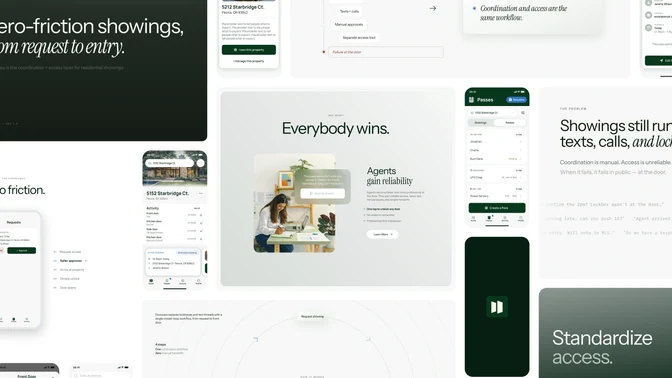
I see a version of this in my own work, building a product that replaces lockboxes with smart access for real estate showings. The old system isn't dumb. At low volume it works fine. The friction shows up at scale. A buyer's agent wants to see a house. She calls or texts the listing agent. The listing agent checks with the seller. Somebody reads out a lockbox code — often the same code everyone showing the place gets. The showing happens, or it doesn't. Nobody's quite sure when, or who, and when something goes wrong the brokerage hears about it late.
The technology to fix that isn't exotic. The hard part was always the coordination layer: getting the right person into the right place at the right time, with real accountability, without burying a small brokerage in overhead it can't afford. The smart access itself — the lock, the permissions, the logs — is software. AI earns its place in the layer above: reading the buyer's agent's text in plain language, checking it against the seller's preferences, drafting the status updates, and kicking the odd case up to a human. It doesn't replace the listing agent's judgment. It clears the coordination drag away from it.
That pattern shows up across most of the local trade and service economy. The big players have brand and buying power and financing and process. What the local firm is short on is bandwidth — and bandwidth is exactly what gets cheap when coordination costs fall. Local operators tend to have things that are hard to keep at scale: real accountability, local knowledge, a stake in the place beyond the transaction. Close the administrative gap without forcing them onto someone else's platform and more communities get to keep capable local businesses. That's worth something.
Regional production and logistics
The same logic runs through the physical economy. A lot of the real difficulty in manufacturing and logistics lives in the paperwork around it: quoting, procurement, demand planning, inventory, scheduling, quality docs, shipping. The informational load can be as brutal as the physical one. It's part of why local and regional production struggle — overseas labor and giant factories are cheaper, sure, but the administrative weight of small-scale production is its own punishment.
A small machine shop competes on speed as much as on cut quality, and now that competition can start the second a quote request lands at four on a Tuesday. The material price moved last week. The foreman's on the floor. The next open slot on the machine is buried in someone's notebook. The customer wants an answer before end of day. A shop where AI can read the drawing, catch the price drift, draft the quote, and propose a slot before a human even looks starts competing on responsiveness it could never afford to hire for. A regional food distributor that can forecast demand and plan routes keeps more margin. A small manufacturer that can handle more product complexity without drowning finds markets that were closed to it.
Not everything comes back, and not every supply chain localizes. The real world still has atoms, trucks, weather, capital limits, and the eternal habit of things breaking right before they're due. But the line where local or regional production starts to make economic sense can move a long way once the coordination tax drops. A lot of the twentieth century's map was drawn around the simple fact that coordinating many moving parts was slow and expensive. Change that and some of the map redraws.
Public systems that function
Some of the highest-value uses won't look futuristic at all. They'll look like a permitting office that works. A licensing process that makes sense. A benefits system that doesn't force people to become their own caseworkers. Public systems break less from malice than from friction — scattered rules, opaque forms, departments that don't share context, overloaded staff, cases that arrive incomplete because nobody knew what was required. So people guess wrong and pay for it in delay.
AI can turn a pile of scattered rules into a guided process, check an application for completeness before a human ever sees it, summarize a case history, and translate bureaucratese into something a normal person can read. Done right, that doesn't replace public judgment; it restores public capacity. The model shouldn't be quietly deciding whether someone loses a license or a disability benefit — rights shouldn't disappear into a black box. But the assembling and formatting and routing and status-chasing around those decisions can and should shrink. The state doesn't need to become all-knowing. It needs to stop losing its own paperwork and making everyone else eat the delay.
More human work, less administrative waste
There's a long list of jobs where the real value is human — doctors, teachers, pastors, tradespeople, small business owners, lawyers — and the administrative work around them grew up to fill the gaps. That paperwork wasn't invented for fun. It was the price of operating at scale. A hospital with a hundred caregivers and a thousand patients had no way to know who'd been seen or what had changed without a huge apparatus of charting and scheduling and billing. A small business couldn't stay legible to the tax authorities without turning every transaction into a documented, routed, archived artifact.
Cheap intelligence changes that math. The doctor gets her notes drafted instead of losing half the morning to them. The teacher stops bleeding hours into formatting and duplicate reports. The small business stays legible without the owner moonlighting as a bookkeeper. The administrative load was never the point. It was the toll for operating inside systems that had no better way to keep track. The best thing AI might do here is retire the toll and let the work go back to being the work.
This doesn't happen automatically
Fine — maybe AI makes these things possible. Why assume anyone builds them? Why not assume the same tools just deepen centralization, make small operators more dependent rather than more capable, and bolt one more layer of process onto public systems?
Fair. The coordination layer that keeps a small firm lean can help a giant firm manage even more complexity. The workflow tools that restore public capacity can just as easily become more monitoring, more reporting, more dashboards. None of it is automatic. Which is the whole reason ownership and governance matter. Whether smaller players keep real control, whether these systems are open enough to actually adopt, whether the technology stays within reach at the household and small-business scale — those aren't footnotes. They're the question.
Questions worth asking
When someone tells me an AI use case matters, I want to ask three plain questions.
Does it remove a real coordination failure, or just produce more output? Faster content is usually faster clutter. More dashboards and emails and a quicker way to irritate everyone isn't a new operating model.
Does it make smaller players more capable, or just more dependent on a central platform? A future where the technology mostly fattens the biggest platforms is available. It isn't the only one worth building.
Does it hand human time back to judgment and responsibility and relationship, or just build a more efficient way to watch people? Cut five layers of management and turn the rest into tighter surveillance and you haven't built the future I'm arguing for. You've built a more efficient version of the problem.
The goal was never just lower cost. It's more capable people, better institutions, and less waste piled around the work that matters. That's what AI makes buildable. But productivity isn't a future yet. Cheaper coordination doesn't, on its own, produce a society anyone wants to live in. That's the next essay: what a hopeful vision should say about work, dignity, ownership, and the shape of a good life once we stop treating people mainly as labor.
More in this series

Part 1 The Transition Is Not the Destination AI is a general-purpose coordination technology. When coordination becomes cheap, the structures built around expensive coordination begin to wobble.

Part 3 A Future Worth Wanting The hopeful vision for the AI age is not mass idleness or elite abundance. It is a society with more dignity, more ownership, more time, and more room for human beings to be human.